As AI moves deeper into clinical practice, a legitimate concern has followed it: If physicians can retrieve an answer in seconds, will they lose some of the expertise that once came from working through the question themselves?
There are already reasons to take that concern seriously. A 2025 study in The Lancet Gastroenterology & Hepatology found that endoscopists who had grown accustomed to AI assistance detected fewer precancerous growths when they later worked without it.
AI is also changing how physicians learn. Studies, guidelines and treatment options that once took hours to find can now be retrieved and summarized in seconds. But while finding information has gotten faster, clinical judgment still develops the way it always has: through experience.
That process can take years.
An IQVIA analysis found that the median time for oncologists to adopt a new therapy is 3.5 years, while only 20 percent consistently prescribe a new therapy within its first two years on the market. Much of that time is spent building the clinical confidence to put new evidence into practice.
Consider pancreatic cancer. At ASCO this year, the Phase 3 RASolute 302 trial reported a near doubling of survival time. Oncologists could find the results immediately. The study alone couldn't tell them which patients were the best candidates, where the treatment should fit in the existing sequence, or what they should watch for when they began using it.
Those decisions draw on something physicians have always relied on: the experience of other physicians.
Evidence-based medicine combines published evidence, clinical expertise and patient preferences. AI is becoming extraordinarily good at retrieving and synthesizing the first. It can also make the accumulated experience of physicians easier to find and learn from.
We're beginning to see that behavior on Vumedi. The physicians who use our AI tools most heavily also spend the most time learning from other physicians. Over the past four years, as AI has rapidly entered medicine, the amount of time active physicians spend learning from peers on Vumedi has risen from about 20 minutes a month to 52 minutes. AI use isn't displacing peer learning – it’s deepening it.
Now those two behaviors are beginning to converge – generative AI answers and peer learning. A physician can ask AI a clinical question and hear how experienced colleagues have approached the same decision, where they agree, where they differ and what experience has taught them beyond what appears in an abstract or guideline.
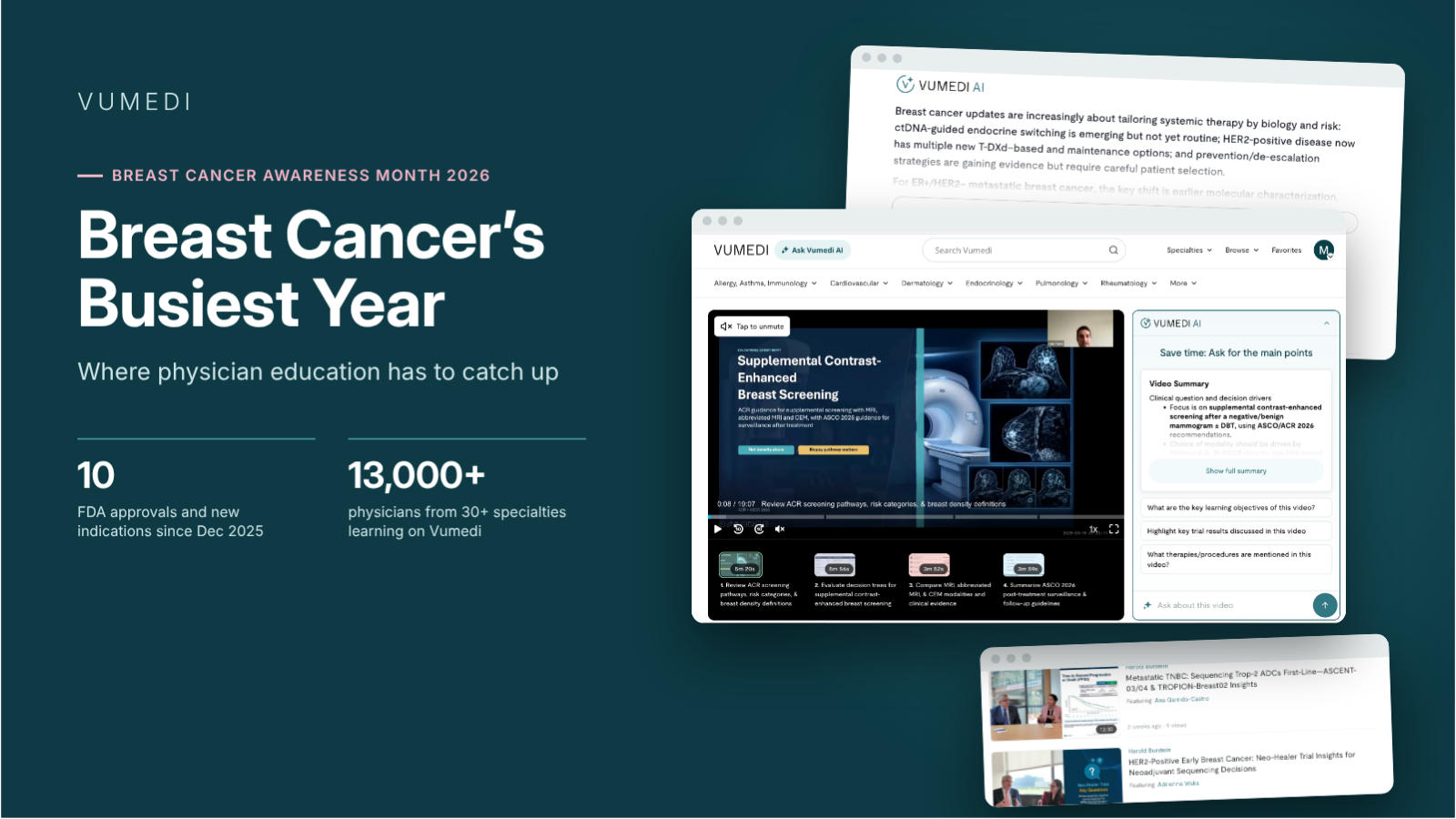
At Vumedi, when a physician asks a question, AI finds relevant moments across more than 2 million minutes of expert video where physicians have addressed it. Instead of replacing the process of learning from colleagues, AI makes those colleagues easier to find.
A physician who has heard experienced colleagues reason through difficult cases is also better equipped to interrogate an AI-generated answer, recognize what it leaves out and decide whether it applies to a particular patient. The expertise AI has been accused of weakening may, in fact, be what allows physicians to use it safely and well.
AI is making the evidence behind new therapies, devices and procedures available almost instantly, and it should become an essential reference tool for every physician. But evidence alone doesn’t change practice. The more physicians rely on AI, the more learning from peers matters. It builds the judgment to put new evidence to work and to recognize when an AI-generated answer is wrong.
AI can put the evidence in front of a physician in seconds. Knowing what to do with it still comes from experience and learning from other doctors.